TRENT PARK HOUSE OF SECRETS – NEW MUSEUM OPENS TO THE PUBLIC
Trent Park House of Secrets, a new museum in a historic country house in Enfield, North London, opens to the public on Tuesday 21 July 2026. The stately home witnessed some of the most pivotal events of the 20th century, and the extraordinary story of espionage, courage and creative deception has remained largely untold for over 70 years.
Trent Park is the former residence of Sir Philip Sassoon, of the Sassoon banking family, one of the wealthiest men in England. In the 1920s the existing Victorian structure was remodelled to his taste. A lifelong bachelor, Sassoon was a close friend of the future Edward VIII and of Winston Churchill and served as an MP and as Under-Secretary of State for Air. Political friends, including members of the Royal Family, were entertained at weekends where they mixed with artists and entertainers such as Rex Whistler, George Bernard Shaw, Noel Coward, T. E. Lawrence (‘Lawrence of Arabia’), Charlie Chaplin and Fred Astaire.
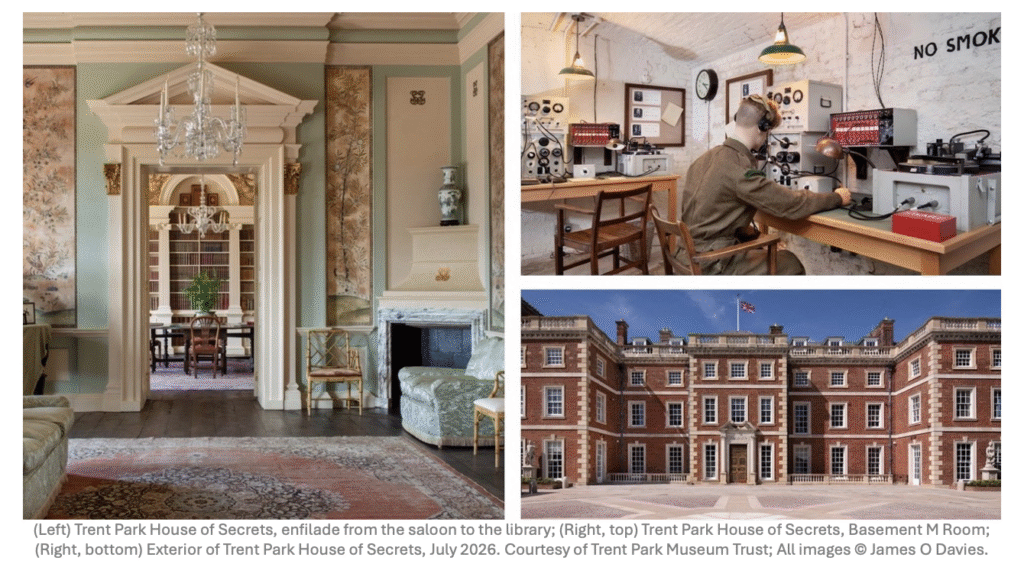
Sassoon died in 1939 and the house was requisitioned by the government as a centre for intelligence operations. Between 1939 and the end of the Second World War, the house played a key role in Britain’s intelligence battle with Germany and is comparable in importance to Bletchley Park. Senior German officers, including 59 generals, were held captive in luxurious surroundings, treated with unusual privileges but unaware that their conversations were being recorded. Vital information was obtained by a complex network of miniaturised bugging devices hidden in every corner: in walls and skirtings, light fittings, plant pots, window ledges, the billiard table, and even the garden benches.
Beneath the state rooms, teams of ‘Secret Listeners’, many of whom were German-speaking Jewish refugees, worked in concealed basement rooms, recording conversations between the captured officers and producing intelligence that gave the Allies a crucial advantage in the intelligence war against Germany.
The new museum brings together these two strands of Trent Park’s history. The state rooms on the ground floor have been restored to their 1930s appearance, with artwork and furnishings belonging to Sassoon returning for the first time since 1939. In the basement the listening stations, offices and working rooms of the Secret Listeners are shown in operation. The museum presents the contrasting stories of peacetime opulence and wartime intelligence.
Dr Giuseppe Albano MBE, Director, Trent Park House of Secrets, said: “Most people will come to Trent Park to discover the covert intelligence operation that took place here during the Second World War. What I hope will surprise them is that there is so much more to discover. Before the war, these rooms played host to conversations between politicians, royalty, writers and artists at a moment when Europe stood on the brink of conflict. We have taken great care to reveal the full significance of the house, weaving together stories from some of the most colourful and turbulent years of twentieth-century British history.”
Lord Cholmondeley and Jason Charalambous, Co-Chairmen, Trent Park Museum Trust, said: “After a decade of fundraising and restoration works, we are thrilled that these extraordinary stories can finally be revealed to inspire and inform the next generation. We are grateful to our dedicated and committed team, our generous donors, and the countless supporters who have helped us open Trent Park House for all to enjoy.”
Helen Lederer, writer and comedian, whose grandfather was a Secret Listener, Trustee, Trent Park Museum Trust, said: “The fact that my grandfather was a Secret Listener was a secret he took to the grave. It means so much that this chapter of little-known history can be told through the museum. To imagine what the Secret Listeners may have felt as they listened to the captive generals upstairs is as important as it is humbling.”
A new model of Trent Park by Ben Taggart is displayed at the end of the State Rooms, marking the shift in the House’s history.
Using original transcripts of recorded conversations, the museum has developed a learning and engagement programme for visitors, community groups and schools, funded by The National Lottery Heritage Fund and the Clore Duffield Foundation. The programme will link to the Second World War strand of the national curriculum and provide an immersive on-site experience that brings to life the extraordinary history of this once little-known operation.