As War with Iran Escalates, New Book Asks: Is Party Democracy Part of the Problem?
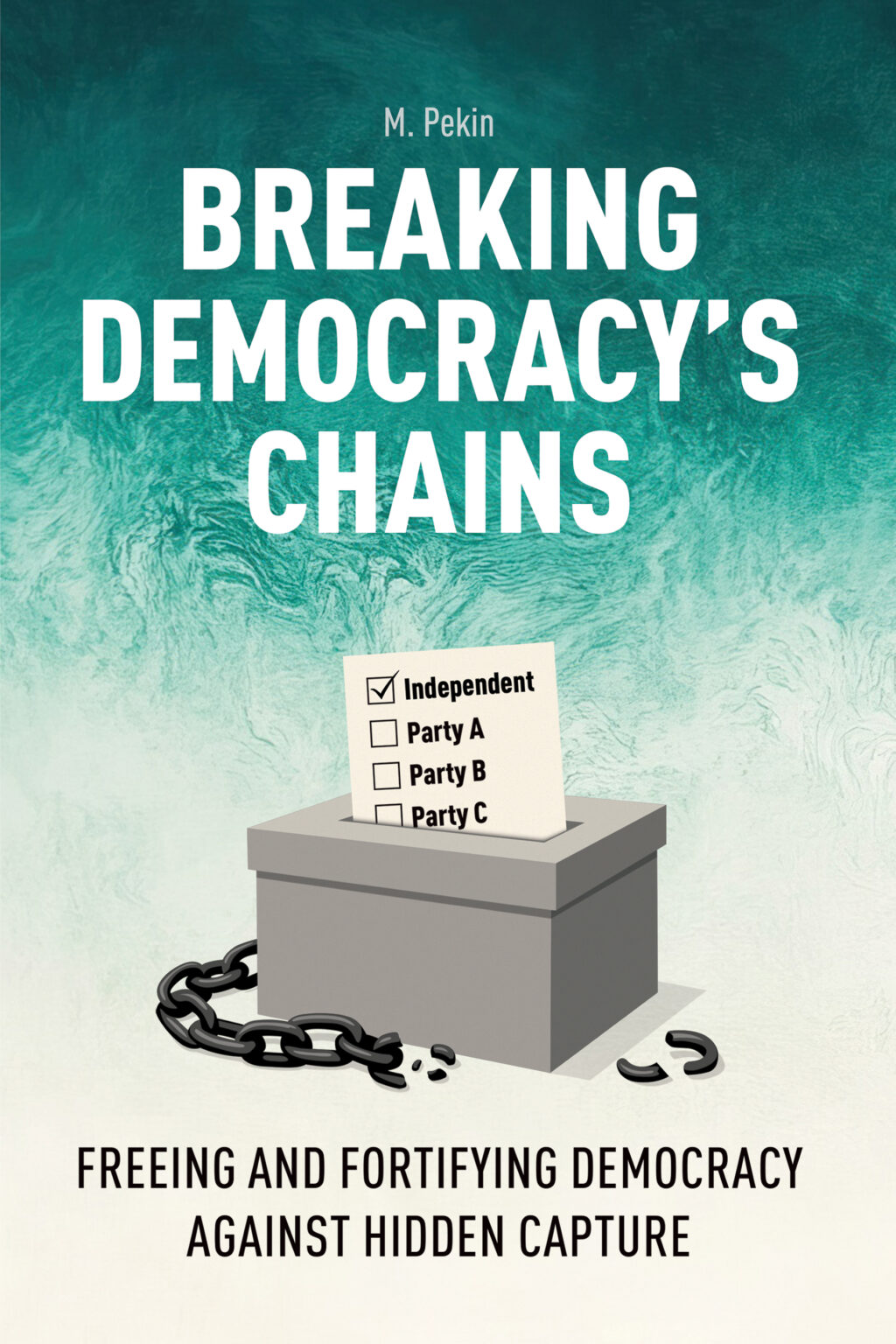
As global attention turns to war with Iran, a new book launching this month argues that the real democratic crisis may not be confined to overt dictatorships but could also be embedded within party-based systems across the democratic world. It argues that major foreign policy decisions are often shaped less by public opinion and more by party systems heavily influenced by special interest groups financing political parties.
In Breaking Democracy’s Chains, serial entrepreneur and political economy graduate Metin Pekin makes a bold and urgent case: modern democracies are not failing because citizens are apathetic – they are failing because political parties have become gatekeepers of power rather than vehicles of representation.
“Modern democracy is on life support. This book tears away the illusion of freedom to reveal how political parties have captured power and how we can reclaim it.” – Metin Pekin, Author of Breaking Democracy’s Chains
From Washington to Westminster, Pekin argues that party machinery now centralises authority, filters candidates, enforces loyalty through party whips, and narrows the range of acceptable ideas. Elections continue. Governments change. Yet structural outcomes—inequality, institutional mistrust, corporate influence, and geopolitical entanglements—remain strikingly consistent.
“We are told we are free because we can vote. But what kind of freedom is it when the options are pre-approved, funded, and filtered before the public ever gets a say?” says Pekin.
Book Extract
After the 9/11 attacks, General Wesley Clark—former NATO Supreme Allied Commander—walked into the Pentagon and was handed a classified memo that stunned him. It outlined a chilling plan: the United States intended to “take out seven countries in five years.” Iraq, Syria, Lebanon, Libya, Somalia, Sudan, and Iran—all targeted for regime change, not because of terrorism or imminent threat, but as part of a broader imperial blueprint. “We’re going to start with Iraq,” he was told, “then take out Syria and Lebanon, then Libya, then Somalia and Sudan, and then finish off Iran.”
Why This Book Matters Now
The current instability in Iran highlights what happens when political systems lose legitimacy and citizens feel locked out of meaningful participation. While Western democracies operate very differently from authoritarian regimes, Pekin argues that there is a shared warning sign: when representation feels performative rather than responsive, public trust collapses.
He makes clear that his new book is not a defence of authoritarian alternatives. Instead, it is a structural critique of party-based governance and a proposal for peaceful democratic redesign.
Crucially, Pekin explores why political events abroad—whether in Iran, Ukraine, the United States or across Europe—inevitably shape politics in the UK:
Foreign policy decisions are often bipartisan within party systems
Economic shocks reverberate globally
Energy, trade, and security alliances are negotiated by party leaderships, not citizens
Institutional trust is increasingly fragile on a global scale
“When democratic systems appear unresponsive at home, global instability amplifies that sense of vulnerability,” Pekin says. “People begin to question not just leaders, but the architecture of representation itself.”
Book Extract
In autocratic states like Russia, Iran, or China, the performance of democracy is staged with brutal efficiency. They have parliaments. They have ballots. They use the language of the people. But it’s a lie. Opposition candidates are jailed or disqualified. Journalists are silenced. Media is controlled. Every institution is wired to preserve a single truth: power does not change hands unless the powerful allow it.
In Russia, “elections” are held while dissenters are exiled, poisoned, or imprisoned. In Iran, candidates must be approved by religious authorities—the people may vote, but only from a list of the pre-cleansed. In China, local voting exists—but the Communist Party answers to no one. The illusion of choice is just enough to prevent revolt. These are not democracies. They are control systems disguised as consent. The outward symbols exist not to empower, but to pacify. Participation is permitted—as long as it changes nothing.
Western democracies wear different masks—but the game is eerily similar. In the United States, citizens are told they live in the greatest democracy on Earth. But look closer. It is a system locked into a two-party stranglehold, where both parties are funded by the
same industries, advised by the same consultants, and protected by the same media networks.
The people “vote”—but the field has already been cleared, narrowed, sanitised. This isn’t a democracy. It’s a well-rehearsed performance. The public is handed a script and told it’s power. In place of bans and brute force, Western democracies rely on:
• Narrative management
• Manufactured outrage
• Carefully engineered debates
• Emotional distraction
And a revolving cast of politicians that differ in tone, but not in allegiance
A Radical but Constructive Proposal
Unlike many books diagnosing democratic decline, Breaking Democracy’s Chains goes further. It proposes a “No-Party Democracy” model built around:
Independent candidates without party labels
Transparent funding structures
Freedom of conscience without party whip enforcement
Direct accountability back to local constituencies
Grassroots nomination thresholds
Pekin argues that cosmetic reforms cannot fix a structurally captured system. Only removing the party bottleneck can restore genuine accountability.