Consumer group urges ministers to act now as housing wealth emerges as essential pillar of retirement planning
Independent consumer group Fairer Finance today publishes its ‘Retirement Compass: the Later Life Finance Index’ at a Westminster briefing with industry and Lucy Rigby, Economic Secretary to the Treasury and City Minister, warning that urgent action must be taken to ensure housing wealth becomes a recognised part of mainstream retirement planning to improve living standards in later life.
The Second Pensions Commission has underlined the urgency of the issue. Fifteen million people in the UK are under-saving for retirement – with one in 10 working age people on course to live their later life in poverty.
Fairer Finance’s 2025 report that found 51% of households aged 60+ in 2040 might need to access their housing wealth to maintain their desired standard of living, unlocking £23bn each year and contribute £21bn each year in gross value added to our economy. Its initial findings from the 2026 Retirement Compass, published in June, found 65% of single female homeowners aged 55-79 face a retirement income below the Pensions UK2 moderate living standard, despite holding on average £225,000 in untapped housing wealth.
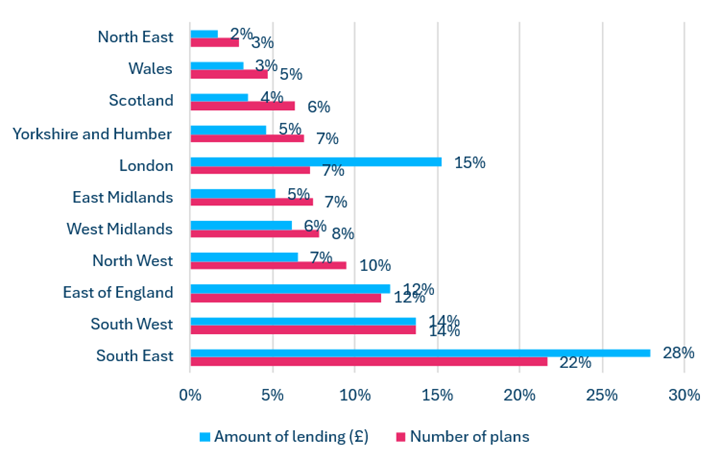
The new independent research from the consumer group, commissioned by the Equity Release Council, combines economic modelling, consumer research and data from all providers in the UK equity release sector, to provide the first comprehensive view on average loan sizes, ages of industry customers and breakdowns by region, gender and loan to value.
Single women emerge as a driving force in Britain’s equity release market
The Second Pensions Commission3 reveals significant inequalities in retirement living standards; on average, women have 48% less pension wealth than men.
Fairer Finance found that single women accounted for 32% of new equity release plans in the second half of 2025, compared to 18% for single men, with the remainder going to couples. This means single women took out new plans at a higher rate than their 29% share of homeowner households aged 55-79 would predict.
Single women were also more likely to be aged 80 or over when taking out a new plan than single men or couples – a pattern Fairer Finance says reflects both women’s longer life expectancy and the scale of the retirement income gap facing single female homeowners. While 11% of all new plan customers were aged 80+, 18% of single women taking out new plans were aged 80+.
Over six in 10 (65%) of single female homeowner households aged 55–79 will not meet the Pensions UK moderate living standard (£31,700 per year for singles), compared to four in 10 (44%) of single male households. This is despite both groups holding similar levels of housing wealth (£225,000 on average). 1.4 million single women aged 55-79 will not meet the Pensions UK moderate living standard despite being homeowners. Of this group, 200,000 single women live in homes worth at least £400k. A third (32%) of women aged 55-79 feel insecure about their family’s economic security in retirement, compared to 20% of men.
A widening regional gap in who explores their options
The Retirement Compass reveals sharp regional differences in how housing wealth is being used in the UK. Over one third of homeowners with low retirement income live in the South of England. Among homeowners with a retirement income shortfall, 72% of couples with £400,000+ in housing wealth live in the South of England – highlighting how much housing wealth is concentrated in a small part of the country.
Almost four in 10 (38%) of single female homeowners aged 55-79 with average retirement income below Pensions UK moderate live in the South of England, with a further 16% in the Midlands.
At the same time, homeowners in the North with a retirement income shortfall are markedly less likely to have engaged with their options than those in the South:
29% said they would be likely to explore downsizing their home, compared to 43% in the South and 36% in the Midlands.
Only 11% said they would explore equity release, compared to 16% in the South and 13% in the Midlands
Fewer had ever previously considered it (10%, compared to 17% in the South and 15% in the Midlands) – despite facing a similar-sized retirement income gap.