Ease burdens on business to tackle youth unemployment, says Alan Milburn
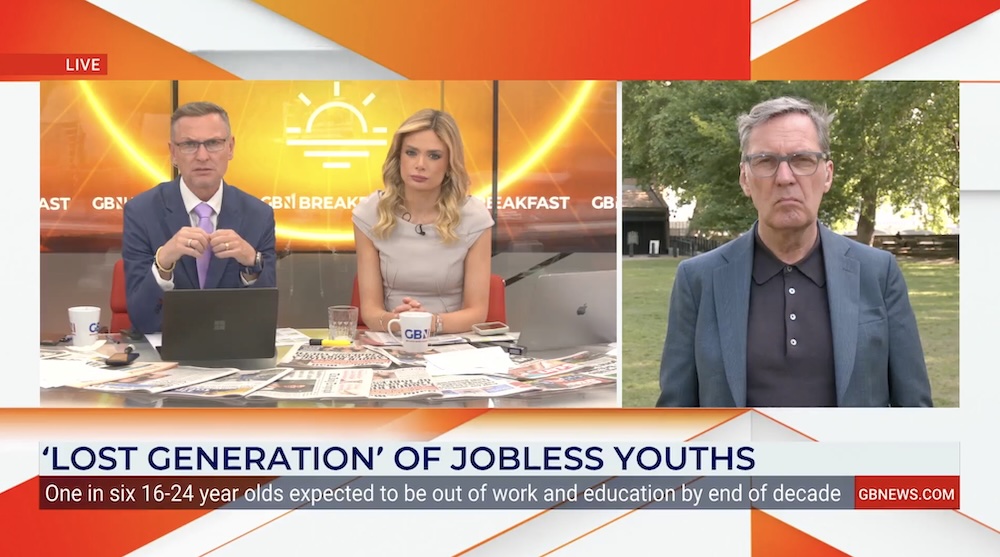
Former health secretary Alan Milburn has said that the government has to ease taxes on business as part of a strategy to tackle the country’s youth unemployment crisis.
His comments came ahead of the publication of a report authored by Milburn on how to tackle the issue, amid predictions that young people not in work or education could hit 1.25 million in the next five years.
Asked if the government needs to back businesses to encourage them to take on young people, he told GB News: “Well, that’s what has got to happen. You’ve got to back business, and every employer I’ve spoken to, and I’ve spoken to dozens during the course of this review, big ones and small ones alike, everybody raises that as an issue.
“It’s a real issue. It’s had a real impact, of course. And if you do want to have more young people in work, then we’ve got to make sure that employers have the right incentives. Every time you take on a young person, it’s a risk, because they’re unproven.
“So the job of public policy of government is to minimise the risks, maximise the incentives, but what no one should do is pretend that the big changes that have been going on in the labour market that have adversely impacted young people for a generation have just begun, they go back decades – 1.6 million fewer jobs, low-skilled, medium-skilled jobs, the death of a Saturday job, apprenticeship starts that have been falling for a decade.
“It’s young people who are right in the middle of that perfect storm. The government can help that, or it can exacerbate it. We need to see more help for business.”
He added: “It’s a criticism of all governments. Look, this goes back decades. If you think about these young people, 6 in 10 of them today, a million of them have never had a job. It was 4 in 10 twenty years ago.
“Let’s not pretend this is an immediate problem that’s just been triggered over the last few years. This goes back decades, and it’s a failure, not just in the jobs market, but it’s also a failure in the welfare system, the school system, the skills system, the health system.
“What we are not doing effectively enough is transporting young people from the world of education into the world of employment. Instead, all too often we’re putting them on a path not to a life in jobs, but to a life on benefits, and that’s what I got.
“It’s got to change. Look, you can’t be spending – for every £25 that you’re spending on benefits for young people, we’re only spending £1 on employment support, even though half of the young people on health and disability benefits, and there are many of them nowadays, half of them want to be in work and they want to be helped to do so.
“That requires a reform of the benefits system, but it also requires a reform of the skills, the education, and the health systems.”
On whether social media use has had an effect, Milburn said: “Social media has played a part in this, but the easiest thing to do with an issue like this, which is complex, is to say there’s one thing to blame: blame the smartphones, blame the young people, blame the employers, blame the government. It’s more than that.
“There’s got to be a big national effort to ensure this generation of young people get the same opportunities as my generation and your generation had, and that was an opportunity to get into work. That is what is missing today.”