‘Guts and courage’ needed to get welfare bill under control, says Iain Duncan Smith
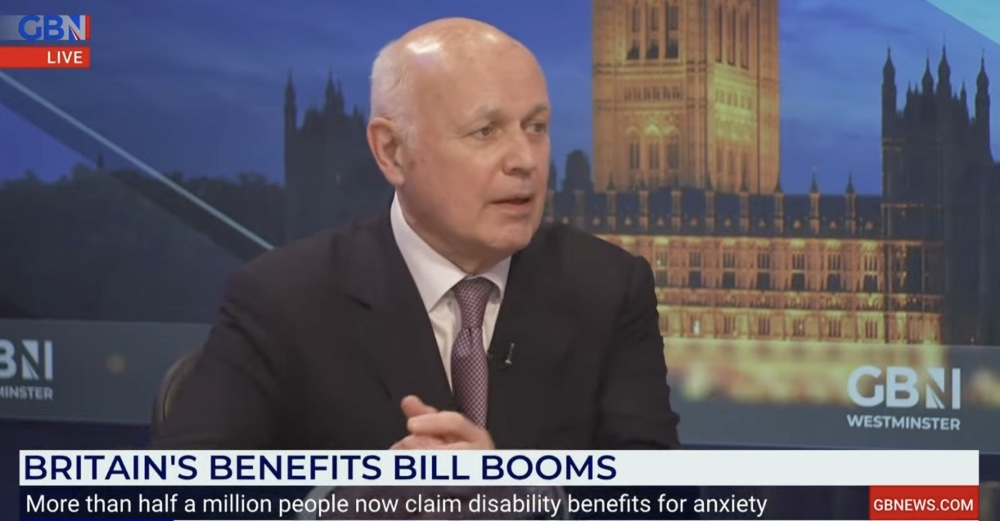
Sir Iain Duncan Smith has said all welfare checks should be done face to face.
Speaking to GB News, he said: “The problem is mental health claims have ripped through. You have disability benefit, but sickness benefit, which is within Universal Credit, is also suffering the same problem.
“The two biggest claims on all of sickness benefits – about 50 to 60% of all claims – are people with depression or anxiety.
“That is mirrored in disability living allowance, but at least with UC, you have a work requirement. And the point about depression and anxiety, before the Covid crisis, we had got the benefits bill down by £25 billion and we’d put caps and checks on all of these.
“The problem with mental health is it’s incredibly difficult to put a check on somebody who says ‘I am depressed.’
“And the number one treatment for depression, which the NHS agrees, is work, and that’s where we should be refocusing this.
“The Centre for Social Justice, which I set up and run, has now done some detailed work on this, and what we should be doing is saying to people who have come out with depression and anxiety, you need work. We’re going to work to get you back into work. We’re not going to pay you a benefit because we’re going to get you into work.
“What we’re going to do is use any savings to get you any assistance and support through talking therapies, etc. to help you be capable of it, but you’re going back to work.
“Work is what we did before the Covid crisis. It all collapsed during Covid, and the result is what we’re seeing now, which is spiralling costs.
“We can get them under control. It needs guts and courage to do it, but you need to make sure that the answer to this is work and work must pay.
“And here’s the other bit of the equation: so many people, young kids particularly, but also older people who have been out of work now can’t get jobs. Why? Because the Chancellor has worked against any idea of making sure work pays by slapping up national insurance charges on part-time work for the first time ever, and on full-time work.
“Lots of small and medium businesses now will not offer jobs to younger people, which is why we have so many NEETs we can’t get into work where we need to.
“So that’s got to change and we’ve got to be tougher on the benefit claims. Those two together, if we make it easier to go into work, will actually make work pay, which is an incentive rather than a disincentive, which is what’s been going on the last sort of three or four years.
“We had severe tests and we came under attack. And those tests, with how far can you walk, what can you do? What is your assessment? The physical assessments can be done.
“They were stopped in terms of the face to face. There were lots of threats made against those doing the checks, and it became rather difficult. But that notwithstanding, everything should be done face to face in the welfare system.
“Anybody that comes out of work, they should be seen face to face. That was dropped during Covid. It’s taken ages to even get that back, we should have got it straight back straight away after Covid.
“There were big delays in that, for some reason. Maybe it’s because it was easier not to hire the people to do it, but face to face is what the system is based on. Why? Because the job centre staff see people a lot who come in for claiming, and they have an instinctive sense, many of them, of who’s not really right, and they will then initiate major checks on them.
“If you just do it purely online, it doesn’t make any sense, and this is what you get, and you do a lot of that without the checks, without the tests. Having said that again. We’re back to the problem of how do you test for depression and anxiety?
“But the one thing you need to say is with depression or anxiety, work is a health treatment, so get them back to work.”