Holtermann Fine Art presents What would Peggy show?
Holtermann Fine Art is delighted to present What would Peggy show? a group exhibition bringing together works by Stefanie Heinze, Rebecca Horn, Rachel Kneebone and Paloma Varga Weisz.
The exhibition takes place at 30 Cork Street, the address from which Peggy Guggenheim (1898–1979) ran her London gallery, Guggenheim Jeune, from January 1938 to June 1939. What would Peggy show? coincides with the Royal Academy of Art’s exhibition Peggy Guggenheim in London: The Making of a Collector.
At Art of this Century, Guggenheim’s New York gallery (1942-1947), Guggenheim staged the female only Exhibition by 31 Women (1943), which included works by Leonora Carrington, Meret Oppenheim, Sophie Taeuber-Arp and Dorothea Tanning. At Cork Street, she gave one person shows to Marie Vassilieff and Rita Kernn-Larsen and included Eileen Agar, Barbara Hepworth and Gisèle Freund in group shows.
What would Peggy show? presents the human body as seen through the eyes of a small group of female artists: Stefanie Heinze (b. 1987), Rebecca Horn (1944-2024), Rachel Kneebone (b. 1973) and Paloma Varga Weisz (b. 1966). The works of each of these four extraordinary artists carry different moods and atmospheres, personal imageries and sexual politics, swinging between intimacy and display, between high seriousness and play.
During her time in London, Guggenheim championed the work of major painters and sculptors of the day, inspiring the question at the heart of the exhibition: if she were alive today, what might she be exhibiting?
Guggenheim was fascinated by dialogues between figuration and abstraction, and between realism and fantasy, with a deep interest in abstract art, Surrealism and sculpture. What would Peggy show? chimes with these interests, looking at contemporary works which might be read as loosely echoing earlier Surrealist concerns.
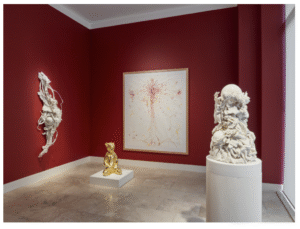
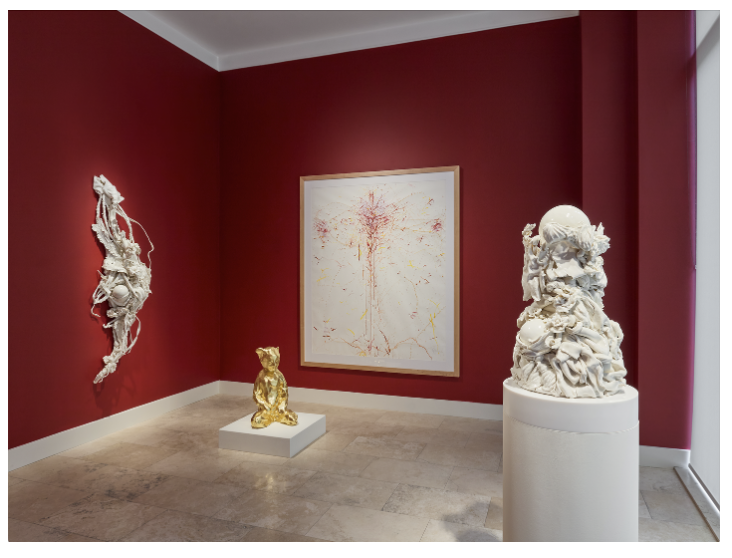
Paloma Varga Weisz’s figurative sculptures often combine human and animal forms, and extend anatomies to make new fantastical, hybrid beings. She works in wood and clay, carving and modelling, working with the aesthetics of different materials and processes that can introduce ambiguities into our readings of material objects and how they have been produced. Wilde Leute 1 (2022), carved in limewood and gilded, looks like an object that has been modelled. Meaning ‘wild folk,’ it suggests at once a feral creature, a character drawn from fairy tale and folklore and a sexualized rag doll, while also evoking gilded religious wooden carvings.
Rachel Kneebone’s porcelain sculptures are carefully assembled, piece by piece, to create complex compositions. The human, and especially female, body sits at the heart of her work. In both Rib (2019) and Totem (2021), rather than build up easily recognisable anatomies, the bodies Kneebone has created are intricate and multipartite, composed like three-dimensional still lives. The whiteness of the porcelain gives these impossible multipartite body-objects a stunning togetherness and formal integrity, as well as a skeletal quality.
The movement, action and experience of the human body were long-standing preoccupations of Rebecca Horn. In Horn’s hands, the body becomes a richly complicated force field of energies, auras and objects, driven by action and change; while her sculptures become highly animated, often performing objects that confront and charm viewers with their eye-catching materialities and their repetitive mechanised movements. The large work on paper Der Blutbaum (2011), which means ‘the blood tree’, is part of her Bodylandscapes series of works and is presented alongside a magical pair of mechanised shells titled Im Inneren des Muschelgehäuses gefangen (2020), which means ‘trapped inside a seashell.’ This automated work captures the frisson of objects fleetingly missing each other, millimetres apart. It also powerfully evokes the inner charge of tightly coiled things.
Stefanie Heinze’s Adorn, ein Muskelvogel (2022), which means ‘Adorn, a muscular bird’ is also presented in the exhibition. The artist has included canaries in many of her previous works and has been drawing the motif since childhood when her family had one as a pet. She is fascinated by what she describes as a duality within the creatures – they are both loners and survivors who keenly observe life in front of them without having control over their own fate. They stand in as a friend, an ally or witness. In Adorn, ein Muskelvogel, the yellow figures of the canary are depicted at various stages of experience, ghostlike.
The exhibition, What would Peggy show? invites viewers to consider the legacy of Peggy Guggenheim and the exhibition programme she staged more than 80 years ago within the setting of her pioneering London gallery.