NEW ACCESSIBLE MOORING BOLLARDS DESIGN AIMS TO MAKE CANAL LIFE BETTER FOR BOATERS
Screenshot
An innovative canal mooring bollard which makes tying up easier for boaters, especially those with disabilities, has been installed at a pilot site on the Grand Union Canal near Milton Keynes.
The project – a partnership between Canal & River Trust, MK Canals, Birmingham City University and the Accessible Waterways Association – will gather data and feedback on the difference the new bollard makes to boaters using the accessible moorings installed this week at Wolverton and coming next month at Fenny Stratford, including evaluation of high-contrast paint designs to help make the bollards easier to see and use.
Canal & River Trust, the charity which cares for 2,000 miles of navigation across England and Wales, believes its waterways are for everyone, and is on a mission to ensure that more people than ever can enjoy them, especially those that find moving about tricky.
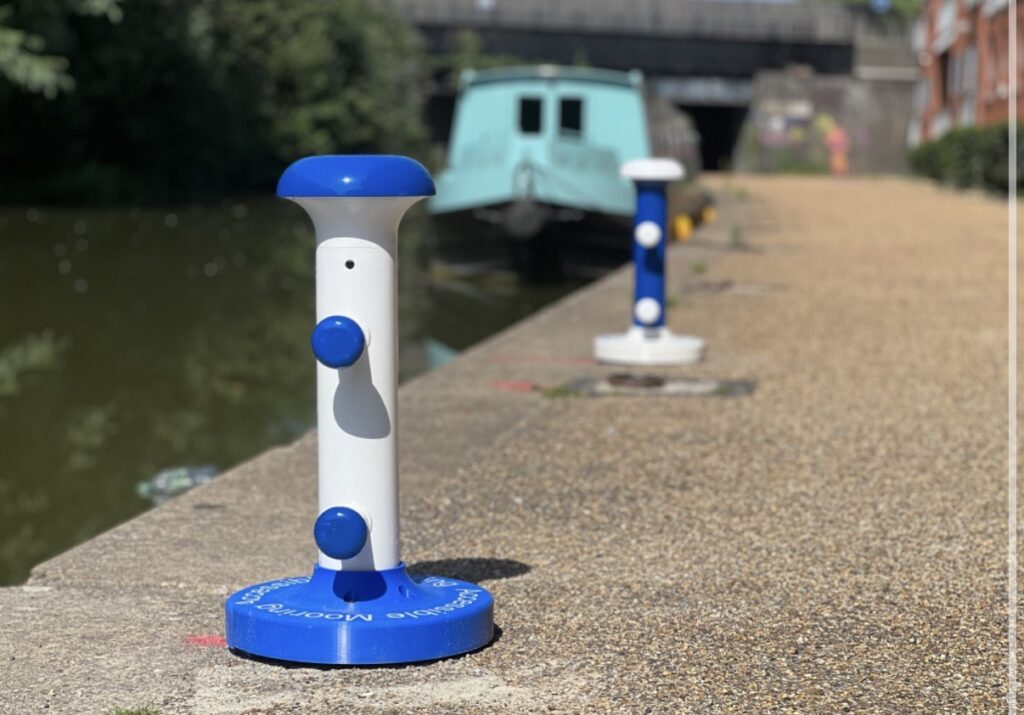
The extra tall design includes two sets of “horns” not normally present on a standard mooring bollard. It’s designed to be easier to use, especially from a seated position on a boat. It’s also easier to see because it’s larger and its markings are brighter than existing bollards – vital for those with poor eyesight – and helps to avoid trip hazards, too. Unlike short bollards or rings, the thin neck design with the “horns” enables a boater to lasso the bollard and pull their boat in to facilitate safe disembarkation.
Dick Vincent, Canal & River Trust National Towpath Advisor, said:
“The ways we use canals today are massively different to when they were built … and the people that use them are very different too. Our traditional bollards have served us well, but our new bollards make them look like a monocle in a world where everyone can order contact lenses online and have them delivered next day. The design and installations at Wolverton and Fenny Stratford are the culmination of years of work with our friends at MK Canals, the Accessible Waterways Association and Birmingham City University, as well as vital input from thousands of boaters who have told us what they need to get more out of their time on the water.”
“But as with any pilot project we need to gather as much information as possible about how the bollards work for boaters, so we’re asking those who use the new moorings to complete a short survey which will allow us to fine-tune the design and I hope lead to many more installations along our charity’s 2,000 miles of canal and beyond.”
Tim Clarke, Director of the Accessible Waterways Association said:
“We are really excited about this. At long last, thanks to the financial and installation support of MK Canals, we can now start the first public trials. This follows many years of developing the concept with the Canal & River Trust, including an initial trial installation of one prototype bollard in Birmingham.
“The design results from many hours of input from disabled boaters, and we are grateful for the hard work that Dick Vincent and his team have put into it to get us to this stage. These two pilot installations in Milton Keynes, we hope, will lead to the final design and the roll-out of more accessible mooring sites across the system.”
David Wolfson, Chair of MK Canals said:
“It’s an honour to have the first real-life test of the bollards here in Milton Keynes. We look forward to hearing user feedback, and to working with local and national partners to start the roll-out process.”