NEW WORK BY ES DEVLIN PART OF V&A EAST’S NEW COMMISSIONS PROGRAMME
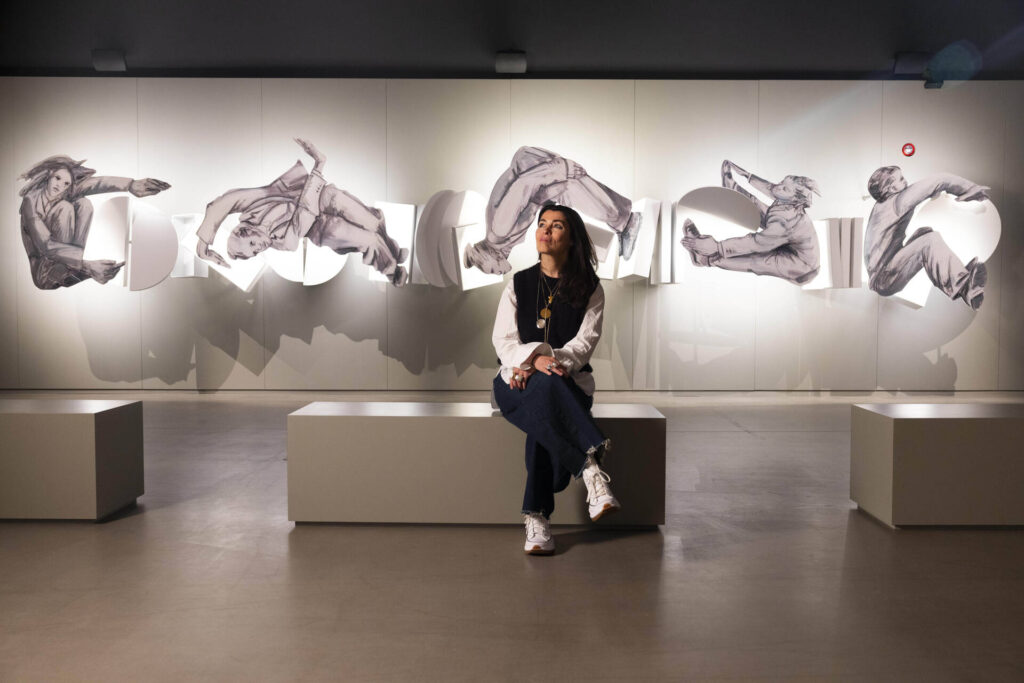
Photo: © David Parry/ V&A
Es Devlin’s The Everythingists (2026), a new 10-metre-wide installation made in response to Natalia Goncharova’s spectacular Firebird (1926) backcloth, which has gone on display for the first time in 15 years, will be shown alongside each other at V&A East Storehouse until 18 October 2026.
Curated by V&A East Senior Curator Madeleine Haddon, The Everythingists has been commissioned as part of V&A East’s new six-monthly rotating creative commissions programme. New Work: Making East London invites artists Tania Bruguera, Es Devlin, Lawrence Lek, Rene Matić, Shahed Saleem, Justinien Tribillon, Carrie Mae Weems and Laura Wilson to each reflect on east London’s layered histories and creative futures.
The Everythingists by Es Devlin
Es Devlin conceived The Everythingists for the V&A East Storehouse in dialogue with Goncharova’s 15-metre-wide painted backdrop made for Diaghilev’s 1926 Ballet Russes production of The Firebird, choreographed by Mikhail Fokine and composed by Igor Stravinsky in 1910. The term ‘Everythingism’, (Vsechestvo in Russian) was coined to describe Natalia Goncharova’s work across painting, theatre design, fashion and performance art.
For the work, Devlin made drawings in charcoal and paint of East London-based dancer Joshua Shanny-Wynter on illuminated plywood cut outs. Shanny-Wynter’s movements were choreographed by East London based choreographer Botis Seva, contorting between suspended rectilinear forms resembling enlarged iPhone and iPad packaging boxes and split oval masks, echoing the storage crates used throughout V&A East Storehouse. The work responds to the aspirations for technology expressed in Natalia Goncharova and Mikhail Larinov’s 1913 ‘Rayonist Manifesto’ and draws on science fiction writer Cory Doctorow’s distinction between centaurs (humans empowered by machines), and reverse-centaurs (machines empowered by humans).
Every 90 seconds the artwork is animated by illumination and underscored by Devlin’s voice reading a series of texts over a soundtrack composed by Polyphonia. The composition is rooted in the horn solo from the finale of Igor Stravinsky’s Firebird Suite. The finale horn theme was conceived by Stravinsky to signify the lifting of the sorcerer Koschei’s curse, the return of light and life, transcendence after chaos. It was based on a traditional folk song found in a collection by Nikolai Rimsky Korsakov.
Devlin reads extracts from Natalia Goncharova and Mikhail Larinov’s techno-optimistic 1913 ‘Rayonist Manifesto’, Cory Doctorow’s 2026 reflections on centaurs and reverse-centaurs in animatronics, Centaur’s Requiem (2003) by American poet Adrienne Rich and The Centaur (1958) by American science fiction writer and poet Clark Ashton Smith.
The Firebird by Natalia Goncharova
The backcloth for the final scene of the 1926 revival of The Firebird was described by Cyril Beaumont as ‘a medley of towers and spires massed in tiers, in the manner of a medieval representation of a walled town, to form a richly decorative pattern’ and it was praised by The Times on 26 November 1926 as ‘one of the most beautiful spectacles which this company has provided either before or since the war.’
Natalia Goncharova’s backcloth has become an iconic image for the Ballets Russes’ ongoing influence and one that is immediately conjured up for theatregoers by Goncharova name. The cloth was used for the final scene, the coronation of Ivan and the Tsarevna, and shows a city of churches with gold onion-domes surrounded by a distinctive wall of a Russian Kremlin. The scene encapsulated all there was to say about Holy Russia (in 1926 apparently lost to the world by the rise of the Soviet state) and aptly reflected Igor Stravinsky’s hymn of thanksgiving. It supports Goncharova’s belief that set designers should seek the truth and spirit of productions avoiding literal representation. As she noted ‘Décor is above all an independent creation, supporting the spirit of the work to be performed; it is an autonomous art form …subject to its own laws.’
The set was created for the revival of Mikhail Fokine’s The Firebird at the Lyceum Theatre, London, on 25 November 1926.The Firebird (L’Oiseau de feu) was an archetypal ‘Diaghilev’ ballet, and one of the most successful of the early works of the Diaghilev Ballets Russes. Premiered in Paris in 1910, it was distinguished not only by Mikhail Fokine’s imaginative and magical choreography and production, but by being Serge Diaghilev’s first commissioned original score from Igor Stravinsky. It was the beginning of a distinguished collaboration between Stravinsky and Diaghilev’s company.
Initially the ballet was designed by Alexander Golovine, except for the leading dancers’ costumes which were by Léon Bakst. By the mid-1920s, when Diaghilev wished to revive the ballet, the original designs were seen as old-fashioned. Diaghilev therefore commissioned new sets and costumes from Natalia Goncharova, whose style, deriving from icons and Russian folklore, with bold colours (bold reds, blues and ochres) and simplified shapes, was admirably suited to the folk tale elements in the ballet.
The set was used for 46 performances by Diaghilev’s Company (21 of which were in London) with the last performance at Monte Carlo on 4 May 1929 (it was also danced in Milan, Paris, Geneva and Marseilles). The set was inherited by Colonel de Basil’s Ballets Russes and revived for them at the Royal Opera House, Covent Garden, London in 1934.
Display history: The Firebird has been shown at a special display for the Antiques Fair, Olympia 1981; at the V&A, London, 25 September 2010 – 9 January 2011 in the exhibition Diaghilev and the Golden age of the Ballets Russes 1909-1929; at The National Gallery, Washington 12 May – October 2013 in the exhibition When Art Dances with Music; Diaghilev and the Golden age of the Ballets Russes 1909-1929. It is now on display at V&A East Storehouse.