PEOPLE WITH LOWER LEVEL MENTAL HEALTH CONDITIONS SHOULD BE IN WORK, SAYS HELEN WHATELY
Screenshot
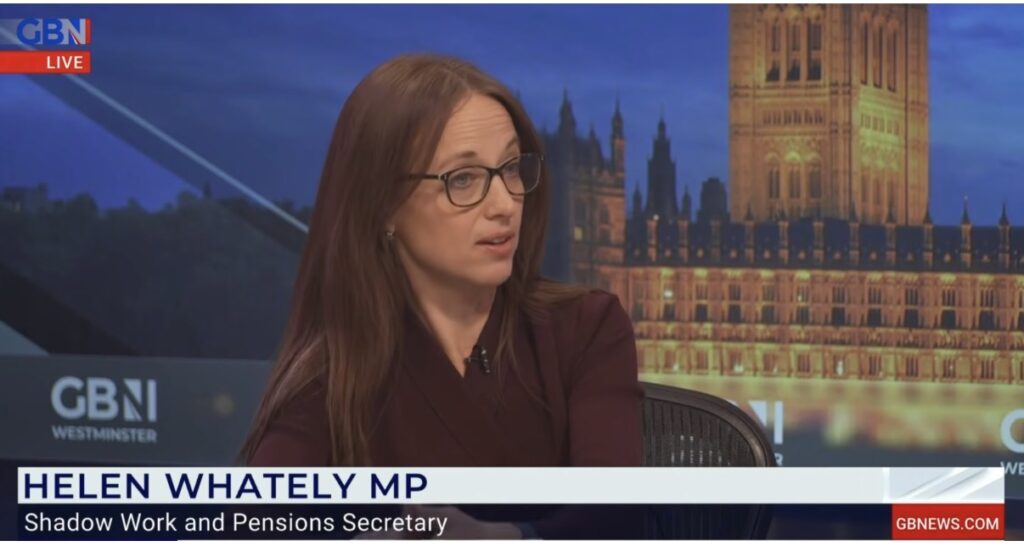
The shadow Work and Pensions Secretary has said the UK’s welfare system is not designed to cope with the surging levels of lower-level mental health
Speaking on GB News Helen Whately said:
“I don’t underestimate for a minute how hard it is to do welfare reform. That’s one reason why it’s so important to do the work in opposition, to both come up with what you’re going to do, which is what I’ve been doing, and making the argument so that when an election comes and when you’re in government, you’ve got the mandate to make those hard changes.
“That’s something that Labour totally failed to do.
“We, before the 2010 election, when we came into government, had done the hard work in Iain Duncan Smith’s famous introduction of Universal Credit, but he did a lot of work in opposition to be able to introduce those welfare reforms, which brought down the benefits bill; we brought down unemployment.
“But that was there because of the hard work and the mandate to do it. Labour didn’t do the hard work on this in opposition, coupled with it’s the same old Labour. I mean, what we’re seeing with the figures that have just come out today and in recent days is the usual thing: unemployment going up, gone up every month under Labour, benefits bill going up and up, taxes going up to pay for all of that, making people poorer.
“Doom Loop on the economy, taking everything in the wrong direction because they fundamentally don’t understand the economy. They don’t understand how businesses work and the damage their policies will do to businesses.
“And they also don’t understand this fundamental thing that if you tax people who are working and pay people to stay at home on benefits, that’s what happens. You’ll get fewer people working and more people staying at home on benefits.
“I think Rob [Jenrick] wasn’t telling the whole story, and many of things he said as he went weren’t the true picture. So with the picture, when we came into election in 2010 brought unemployment right down and benefits down.
“Then something happened from 2019, particularly through the pandemic and afterwards, which was a rise in the number of people claiming sickness benefits. That’s driven by mental health claims, and, worryingly, particularly younger people claiming for mental health as well.
“That was something that was happening. I know that Mel [Stride] worked on reforms, some reforms that got resisted, challenged by the lawfare challenge, and reforms that were in the manifesto and then got cancelled by Labour on turning up in office.
“I’ve taken on this job, and I’ve gone further, really doing the work on what we would do. We identified and announced in the autumn, £23 billion worth of savings.
“One of the big areas of that is stopping giving people sickness benefits for lower level mental health and the lower level of neurodiversity, things like ADHD, because that is driving up the benefits bill.
“But also, there’s lots of evidence that people with those kind of mental health problems will be better off in work anyway.
“It’s definitely true that we need to have a welfare system which does support those who are seriously ill, seriously disabled. We don’t want people to be completely destitute if they are those who are really, truly unable to work.
“However you can only do that if you’re making sure that those who can work do work. The welfare system we have hasn’t been designed for world in which people are coming forward with lower level mental health problems.
“We did work in government to try and reduce the stigma of mental health. That was the right thing to do, but it’s kind of gone too far with people coming forwards with mental health conditions.
“And obviously that’s why you have to be really clear that we just have to say actually, for those lower level mental health problems, and I’m not talking about severe psychosis, the sorts of reasons why people might be in a mental health unit, having inpatient care, they’re not those sorts of things.
“But I should be very clear that for those lower level things; no, you may need support, you may need help, but you will be in work, not receiving sickness benefits.”