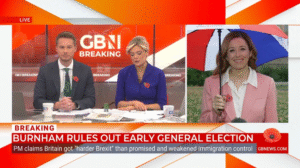
Burnham’s giveaways are risking economic stability, says Jacob Rees-Mogg

Sir Jacob Rees-Mogg has said that the prime minister is risking economic stability with a spending spree that gives trivial benefits to people.
He said on GB News: “Now, what is this spending spree? Well, it’s £2 bus fares. It’s a cut in some rates, but not very many rates, and it’s a minuscule cut in VAT of electricity bills, which cabinet ministers keep on calling energy bills, forgetting that most energy bills actually come in the form of gas.
“One wonders whether they are disingenuous or merely not very up on their brief. £1.8 billion pounds so far, but where is it going to come from?
“We know that the country doesn’t have a lot of money. We know that we are as heavily taxed as historically we ever managed to be taxed.
“If you look at the figures going back over decades, 38% is about the ceiling as a percentage of GDP that people are willing to pay in tax, and yet this expenditure is already 44% to 45%.
“You have this 7% gap that will only get bigger if Burnham keeps on spending your money, and you see why he’s doing it.
“He wants to make a good impression. He wants to show that he knows what he’s doing, and he wants to spread sweetness and light in the early days of his administration. He wants to be different from Sir Keir Starmer.
“The problem is bills have to be paid. There is not a magic money tree – that went out with Jeremy Corbyn. It hasn’t suddenly regrown in the garden of Downing Street or perhaps in Chequers.
“And therefore Kemi Badenoch is absolutely right to be saying, will he rule out tax rises to pay for this expenditure? Because otherwise we’d hear all summer a nice little headline-grabbing expenditure piece day after day, and then a whopping great bill come the Budget.
“Remember what happened last time when Rachel Reeves took over, and there were rumours of tax rises, and that destabilised the economy. It undermined growth. It stopped investment. It led to decisions being made because of the fear of taxes that then, in some cases, weren’t even increased.
“What is happening is risking the stability of the economy, whilst providing essentially trivial benefits.”